What is agentic testing? An AI QA agent that plans, runs and judges the test.
Agentic testing is software testing in which an AI agent is given a goal rather than a script. The agent decides the steps toward that goal, carries them out in the real application, and judges whether the result is what the goal said should be true.
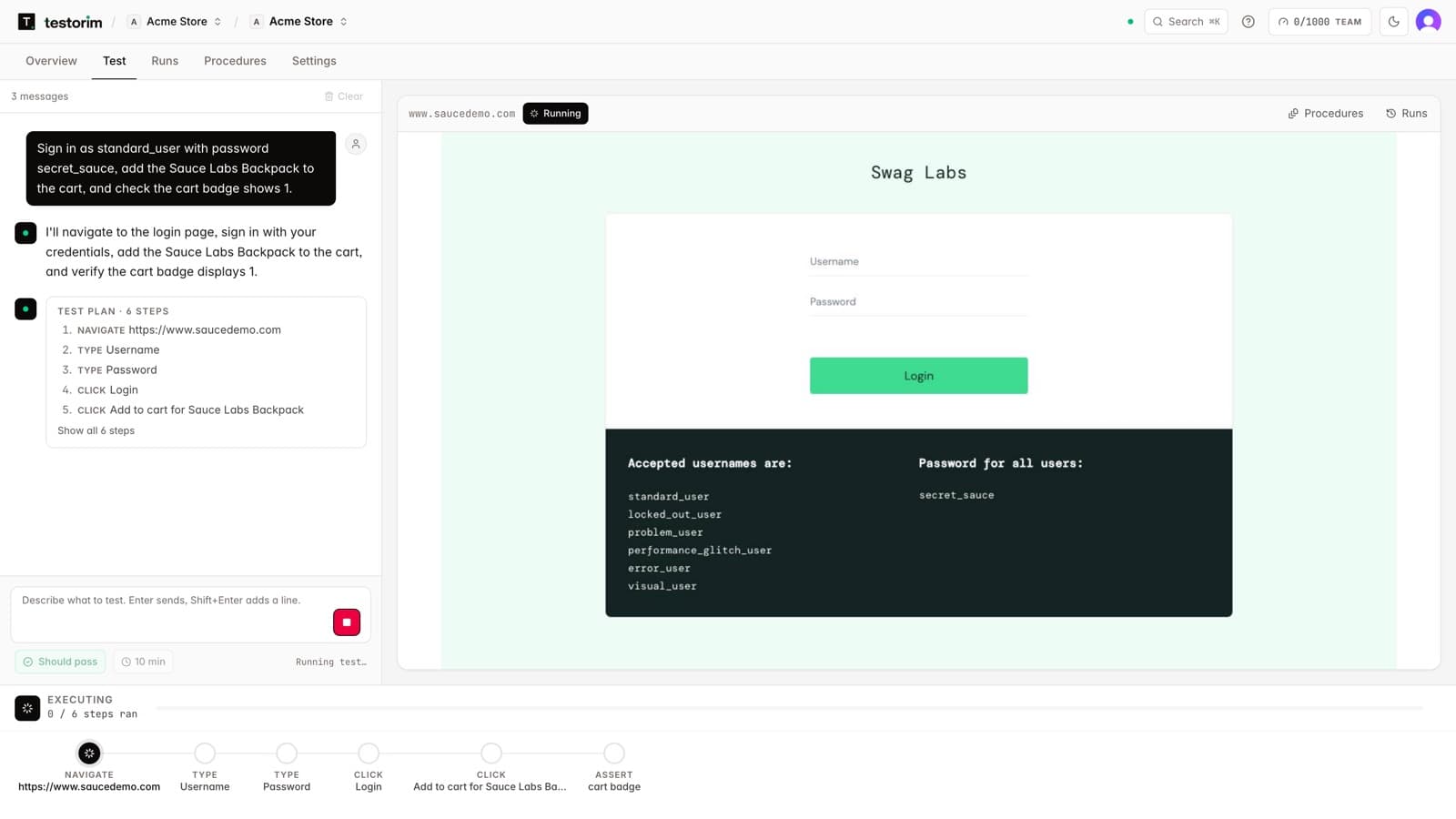
In Testorim you write the goal, such as “a new user can sign up and sees the dashboard”. The agent plans the steps, runs them in a real browser, checks its plan covers what you asked, and tells you whether it passed, failed or needs a person to look.
Join the waitlistScripted, recorded and agentic tests.
| Approach | Who writes the steps | What breaks it |
|---|---|---|
| Scripted tests | An engineer, in code, one locator at a time. | Any change to the page's structure the script names, until someone edits the code. |
| Recorded tests | Whoever recorded them, by using the app once. | The same, and the recording has to be made again to fix it. |
| Agentic tests | The agent, from the goal, on the page as it is when the test runs. | A change to what the app does. Most changes to how the page is built are not: the agent finds each element again on every run and records which one it used. |
What the agent does in one run.
- 1.
Plan
Turns your goal into browser steps: which pages to open, what to click and type, and what to check at the end.
You see: The plan, shown before and during the run.
- 2.
Check its own plan
A second model reads your request against the plan and lists anything you asked for that no step checks. The agent then writes the missing check, or marks it as not covered.
You see: A note naming the checks it added, and any it could not.
- 3.
Find each element
Looks for each target by role, label, placeholder and visible text. When those are loose or miss, a model picks the element from the live page in front of it.
You see: Which element each step used.
- 4.
Act and wait
Clicks, types, selects and presses keys in a real browser, then waits for the page to settle before the next step.
You see: A screenshot before and after each step, and a video.
- 5.
Judge the result
Decides passed, failed or needs review, and for a failure, whether the app or the test is at fault.
You see: A written report built from what the steps observed.
Who decides what.
An agent is only useful if you know where its decisions stop. In Testorim the agent owns the how; you own the what, and anything that changes what counts as a pass.
| Decision | Who makes it |
|---|---|
| What should be true when the test ends | You. The goal and the expected result come from your sentence. |
| Which steps get there, and in what order | The agent. |
| Which element on the page each step means | The agent, on every run, from the live page. |
| Whether the plan covers what you asked | The agent checks, and says what it added or could not cover. |
| Whether the app should refuse an action (a negative test) | You, with the Should fail setting or by asking for the refusal. |
| Which run becomes a saved test | You. Nothing is saved until you save it. |
| A code sent by email or SMS during sign-in | You, when you are watching: the run stops and asks you for it. |
| What to do about a failure | You. The agent says what failed and whose fault it looks like; it does not change your app. |
What the agent does not do.
- It does not explore your site on its own. Every run starts from a goal someone wrote.
- It does not rewrite a saved test. A replay runs the saved steps without planning them again; when the flow changes, you describe it again.
- It does not pass a run it could not confirm. A check it could not read the way you asked is marked needs review, not passed.
- A run nobody is watching, such as a scheduled or CI run, cannot stop to ask for a code, so that step fails and says why.
Quick answers
What is agentic testing?
Testing where an AI agent is given a goal and decides the steps toward it, carries them out in the real application and judges the result, instead of following steps a person recorded or scripted. The person states what should be true; the agent works out how to check it.
What is an agentic QA tool?
A QA tool whose tests are run by an AI agent rather than by a script. Testorim is one for web apps: you describe a test in plain English, and its agent plans the steps, runs them in a real browser, checks that the plan covers your request, and reports a verdict with a video, a trace and a written report.
Is agentic testing the same as autonomous testing?
They overlap. Autonomous testing often means a tool that also decides what to test, for example by crawling the site. Testorim's agent decides how to test a goal you give it, not which goals to test, so every run starts from a sentence someone wrote.
Can an AI agent replace a QA tester?
It can take over the repeated checks: the same sign-in, checkout and forms before every release. Deciding what matters, exploring a new feature and judging a design still take a person, and the agent's reports are written for that person to read.
Can a coding agent run the tests?
Yes. The testorim CLI includes an MCP server, so Claude Code, Cursor, Codex and other agents can list your tests, run a saved one or describe a new one, and read the verdict and the failing steps before they finish a change.